Category: Cornwall Edition

North Cornwall Book Festival

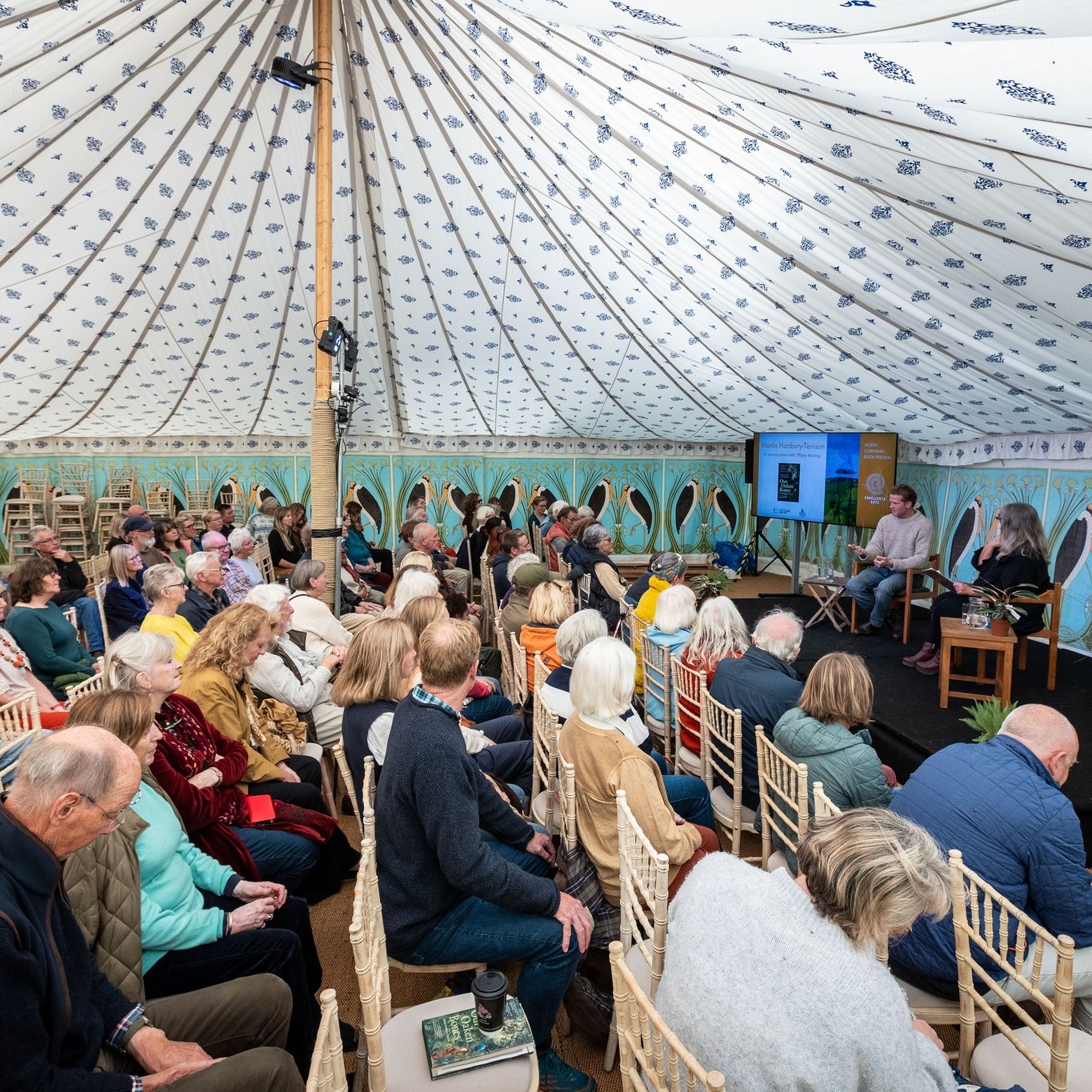
We’re looking forward to this lovely panel event, Cream of Cornish, in which Peter McAllister will lead a discussion of Cornwall in Short with fellow anthology authors Shelley Trower, Clare Howdle and Kate Horsley at North Cornwall Book Festival in just over a week at 10-11am 27 September.

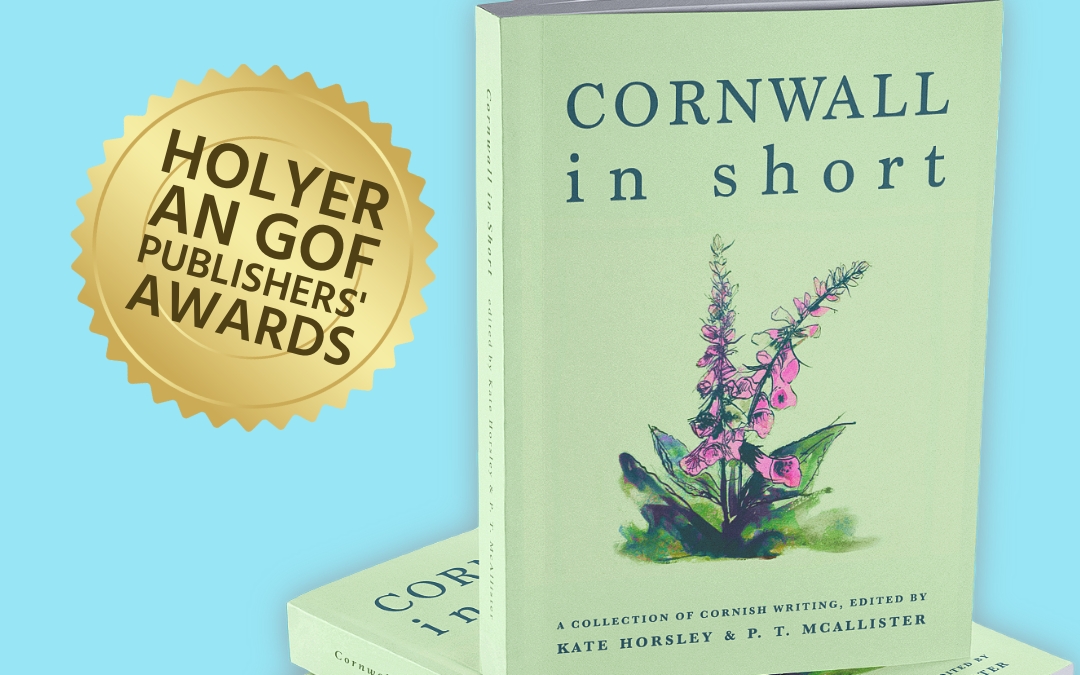
Join Peter McAllister and other writers who contributed to the 2025 Holyer an Gof shortlisted anthology, Cornwall in Short. With Gripping stories that showcase fresh and established talents alike, Cornwall in Short engages with folklore, history, architecture, and landscapes in an emotionally compelling thrust that celebrates a love of all things Cornwall.

The event will feature Peter McAllister, Clare Howdle, Shelley Trower, and Kate Horsley.

Penzance Literary Festival

Penzance Litfest Panel Event

Our co-founder and editor, Peter McAllister, will be leading a discussion with Jackie Taylor, Rob Magnuson Smith, Adrian Markle and Emma Timpany at Penzance Litfest, & they’ll be reading from our Holyer an Gof Publishers’ Awards-shortlisted anthology, Cornwall In Short!

Book here: buff.ly/H8AWToG

Cornwall in Short Book Launch

Join editors Peter McAllister and Kate Horsley, along with a number of contributing writers at this, the launch of Cornwall in Short. Authors such as Tim Hannigan, Emma Timpany, Rob Magnuson Smith, Adrian Markle and Clare Howdle feature in this collection of Cornish writing. Hear some of them read their work at this event before taking part in a short Q&A.

A Place to Heal

by Mark Holman

A multi-disciplinary creative, Mark Holman’s practice initially focused on figurative subjects – both sculpted and drawn. Recently, his process has drawn on parallel creative ventures as an actor, musician and horticulturalist, evolving beyond the purely figurative to focus on human connections with nature in a more social engaged way. The goal of Mark’s current projects is to engage community and encourage discourse, supporting sustainability and promoting healthier relationships with the environment. He is a featured artist in our Cornwall Edition.

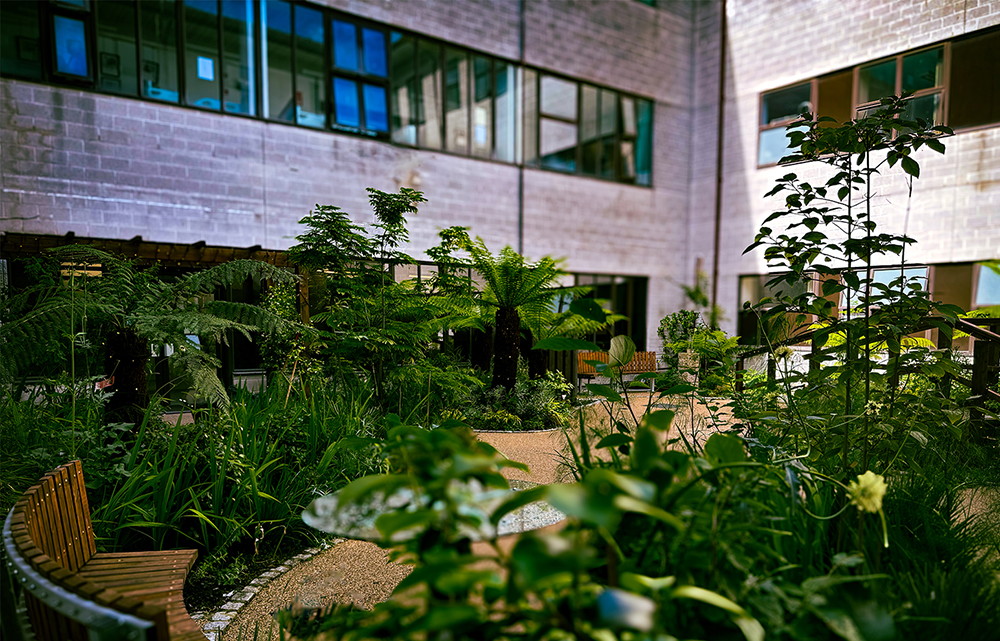
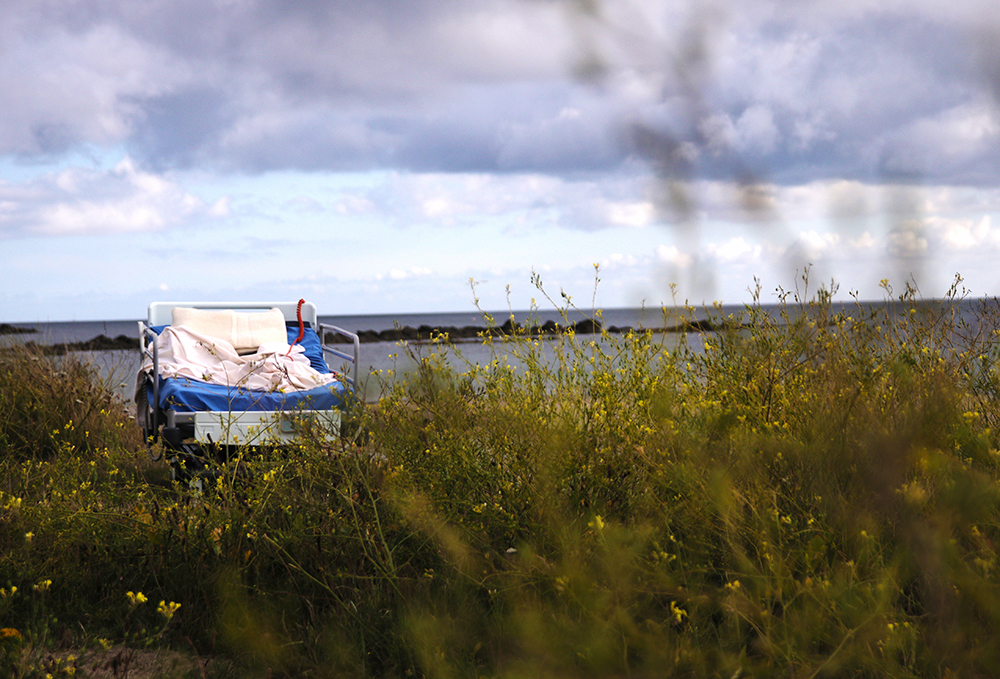
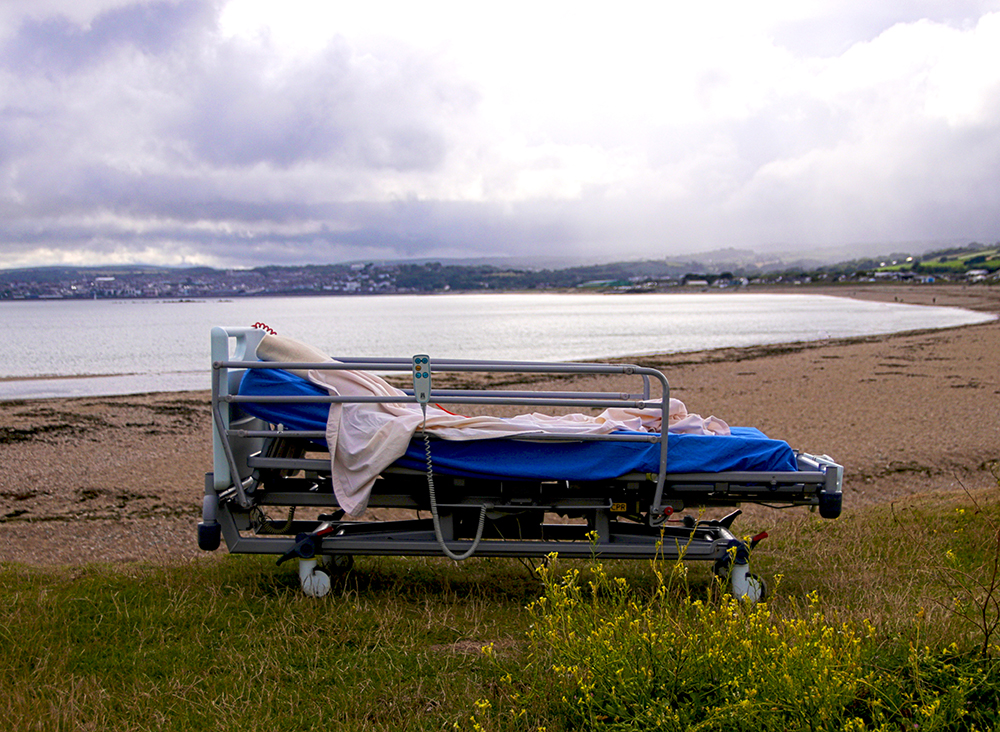
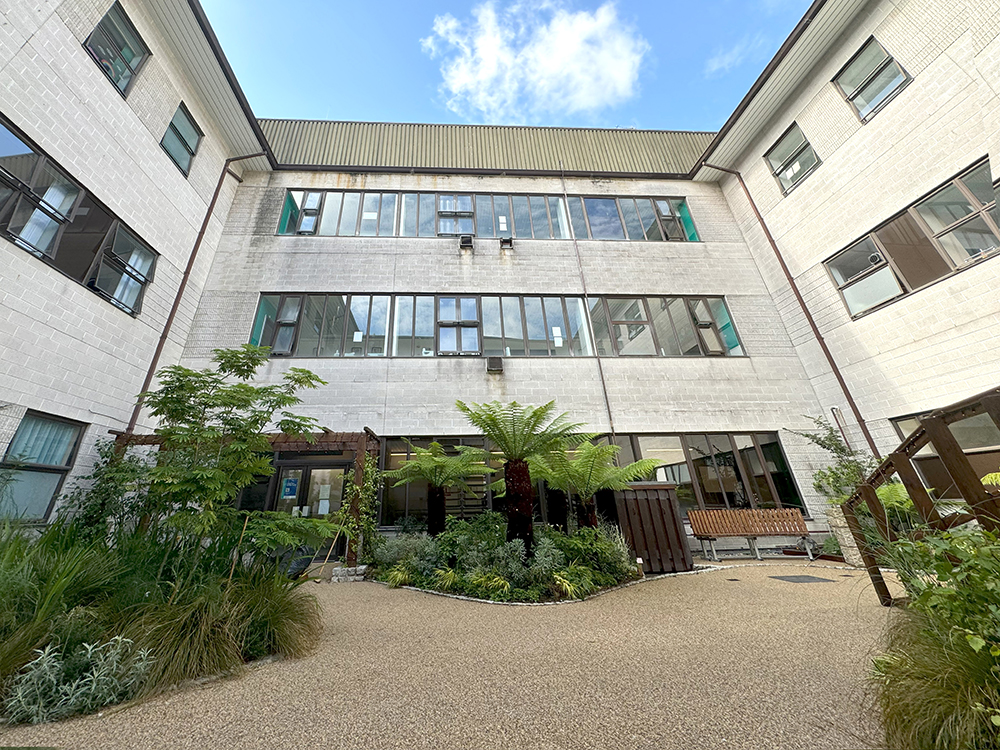
When I was approached by a local Hospital Trust to help create a garden that enabled Intensive Care Patients to recover within nature, I jumped at the opportunity to make a difference in a tangible way. The garden I designed – underneath the critical care unit at Royal Cornwall Hospital NHS Trust in Truro – is one of the first therapeutic gardens in the UK that enables very ill patients to spend time outside with the help of life-support technology.

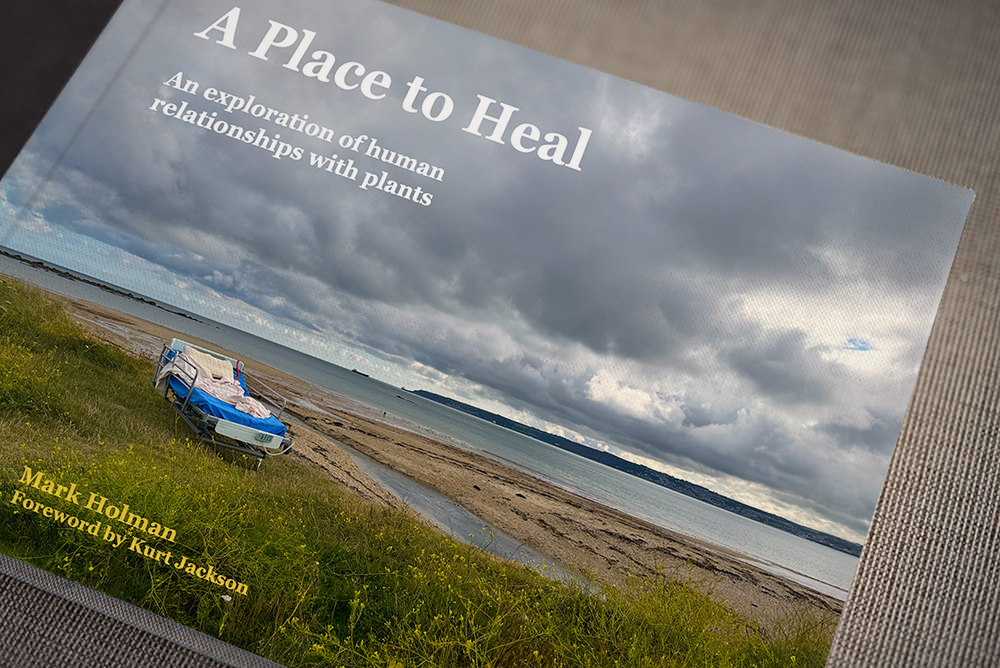
Mark’s book, A Place to Heal, is available to buy here.

The garden contains a combination of sensory plants, hospital bed areas, and seating spots for families, carers, and medical professionals: a space where the patients can be surrounded by a therapeutic combination of friends, family and nature. Kym Vigus, RCHT Critical Care Staff Nurse, calls it “a huge asset to our unit” that generates “incredibly positive experiences” for patients: “For clinical teams to be able to bring patients down to the courtyard to feel the fresh air and see the sky, to smell the plants and hear birdsong, is very special.”

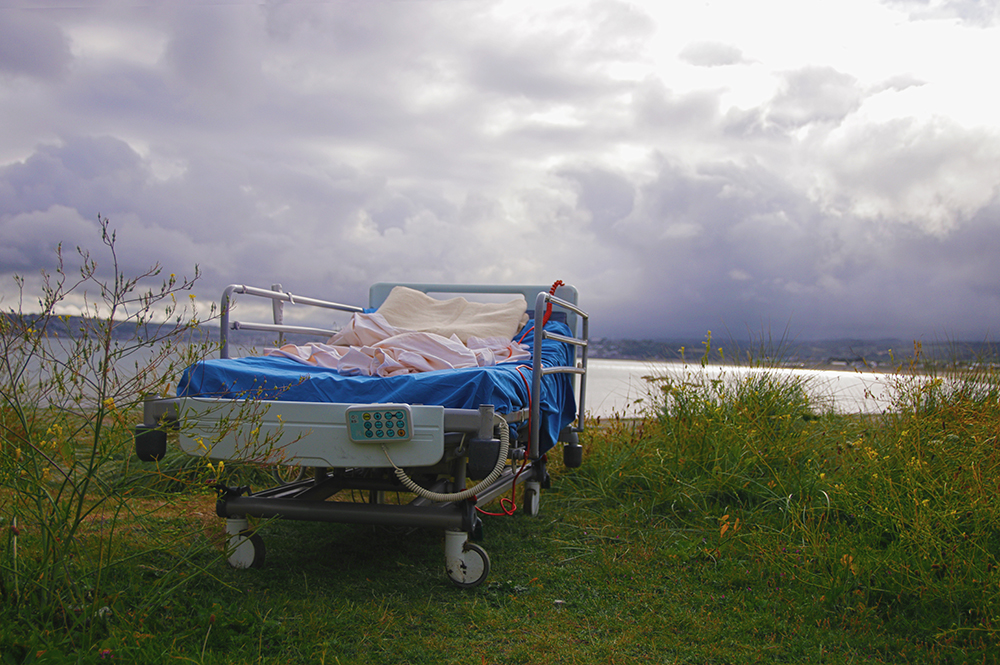
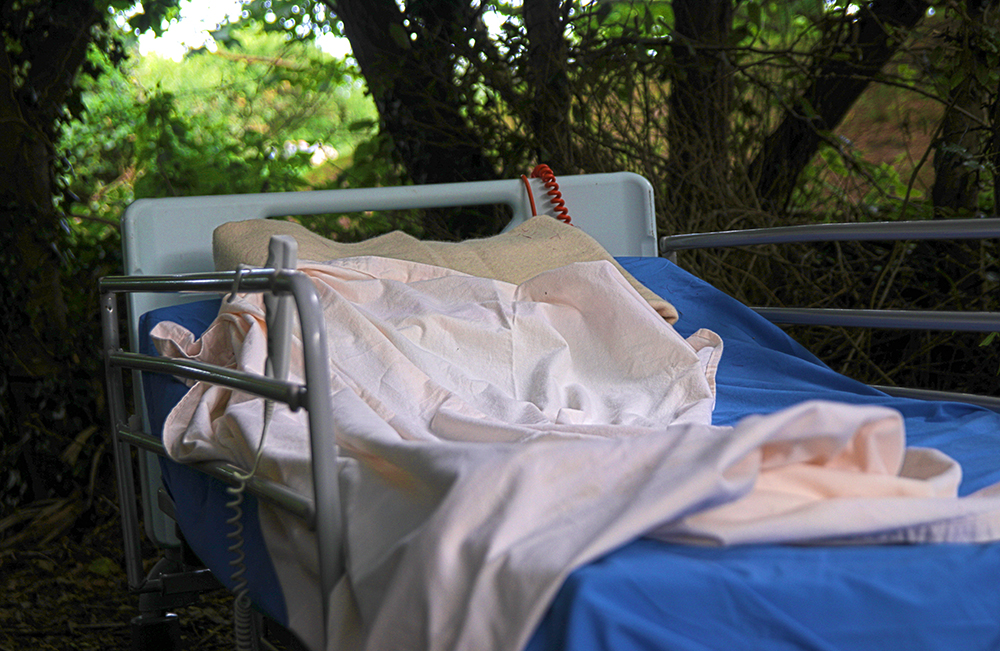
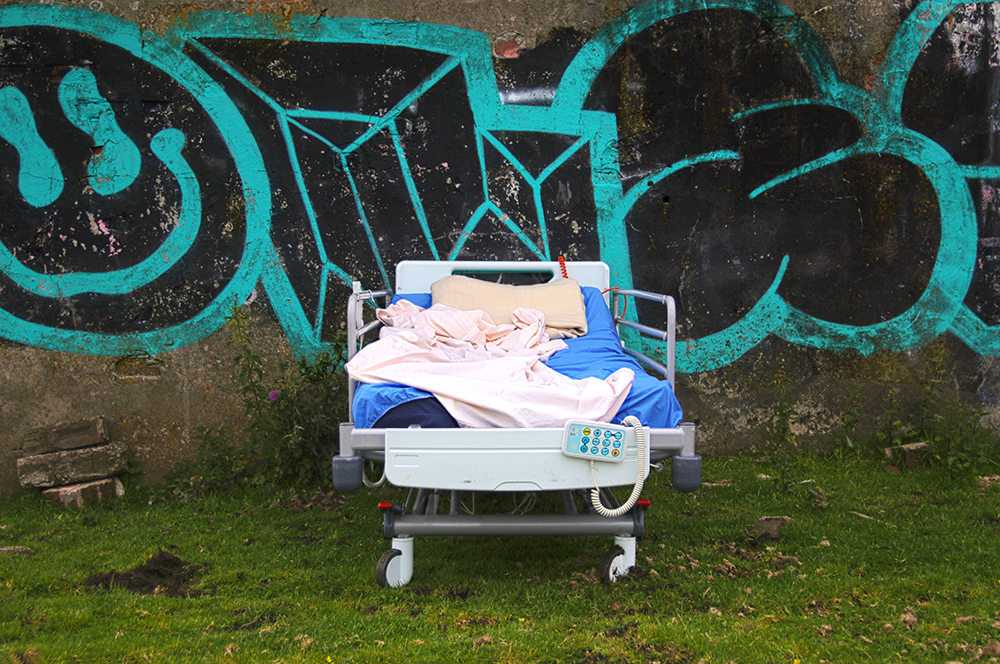
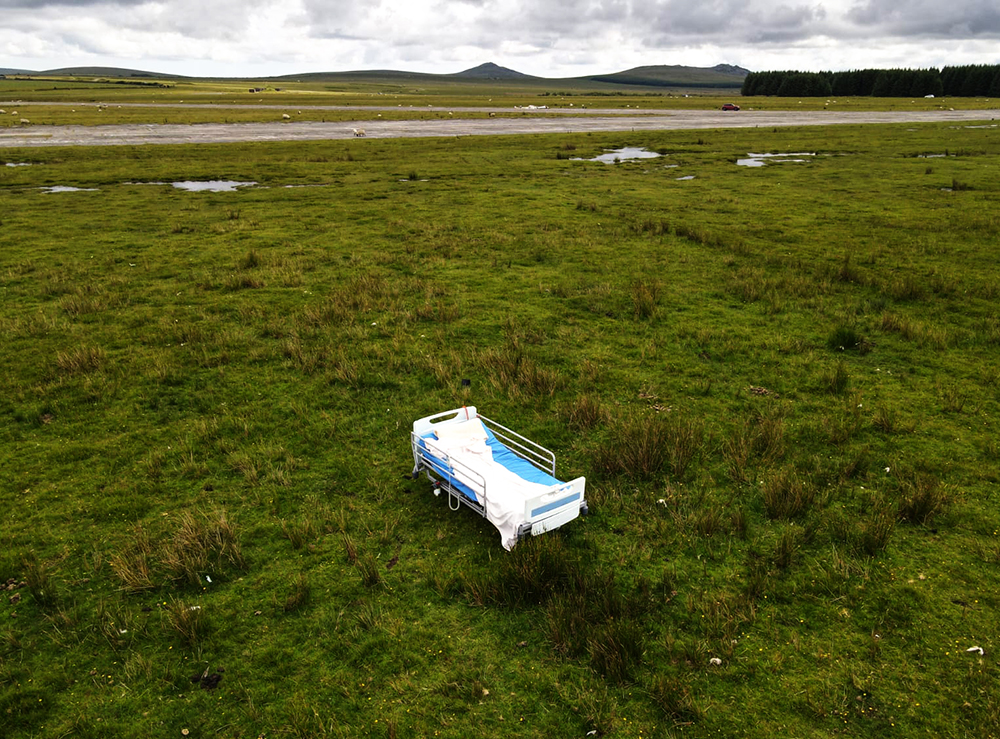
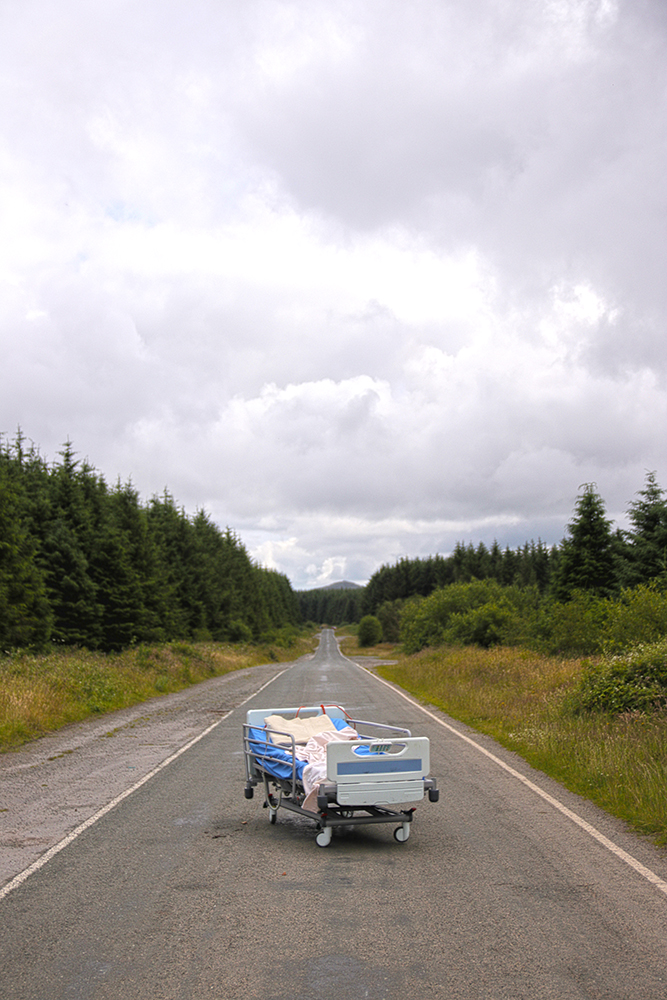
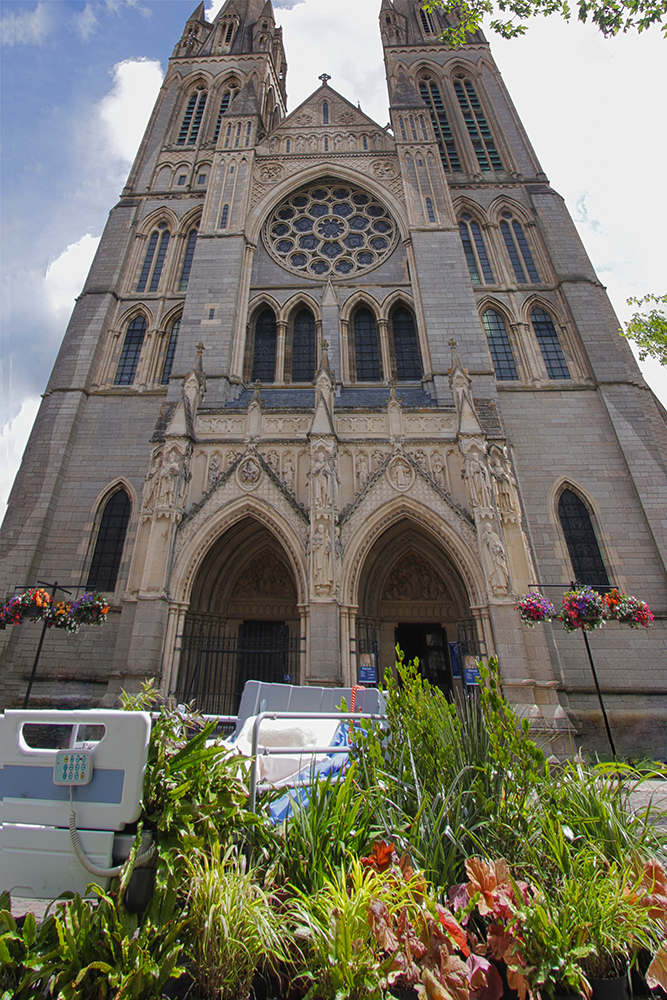
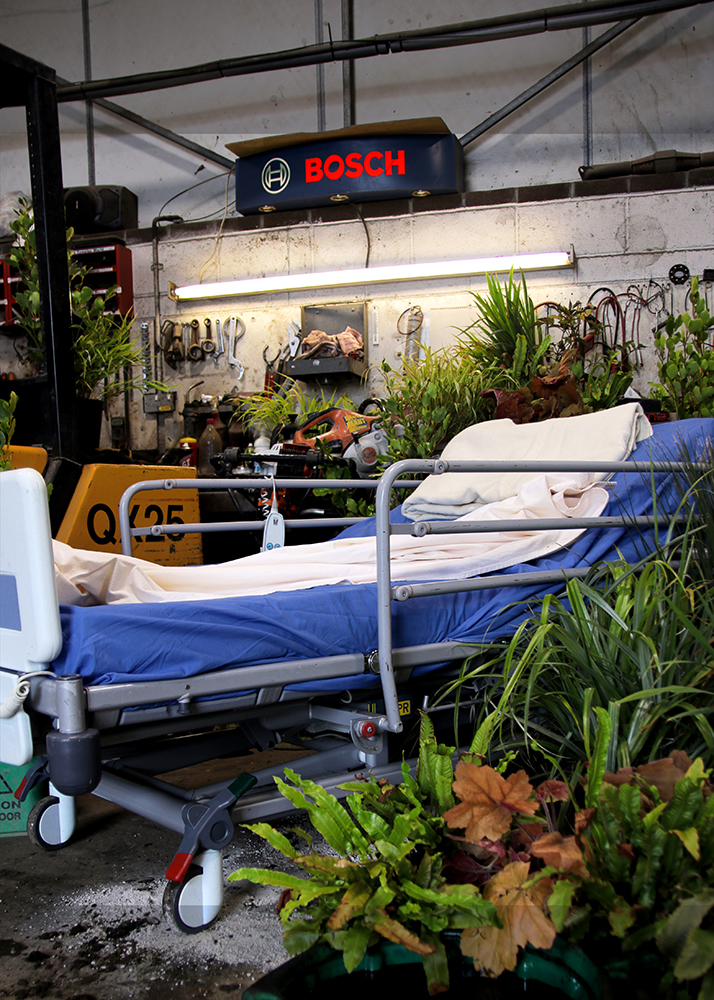
‘A Place to Heal’ evolved from my work designing and installing the therapeutic Healing Garden, a project which planted the seeds of an idea for a sculptural installation in which a reclaimed hospital bed would be planted with local botanical species so that it looked like it was coming out of the ground. This installation was first exhibited to the public at the Royal Cornwall Garden Society Show. It continued in five different locations around West Cornwall, with the bed eventually moving to Victoria Square, in front of Truro Cathedral.

We were lucky to get the artist Kurt Jackson involved, both with the garden itself, and a book of art and writing that grew out of the bed tour. An exploration of relationships with plants, why we need nature and why we need to work to preserve it, the book sets out to explore how plants can heal us and how we can heal the environment.

As we ferried the bed from one location to another, we chatted to people about the Healing Garden project, the benefits of nature, and how regular engagement with nature can have positive effects on both mental and physical health.

In the gallery of images below, I have placed a hospital bed in a series of different environments to explore the effect landscape has on it. We captured some amazing photos that symbolise the ways our surroundings affect our ability to heal. With projects like the Healing Garden, green social prescribing, and installations like ‘A Place to Heal’ as public conversation-starters, we are hopefully moving towards greater engagement with how healthcare strategies meet the natural world.

Gallery

The Last Lonely Person on Tuna Street

The Last Lonely Person on Tuna Street

Short Story

by Becky Wildman

A few days ago, I was walking alone along Tuna Street, and there, rising towards me like a tsunami of land, was the ground. Not the ground beneath my feet, the ground about twenty steps in front of me. Tipping up on itself like the world was a piece of paper, folding away. The grey of the pavement, with lines of houses either side, the green wheelie bins, a red car on the road, all rising. It collected into this huge object in front of me, not made up of its individual parts anymore but one threatening mass. The sky bent down behind me out of view, and I was just a word on the page, smashing into another word from the other side.  

I had just then been thinking that if I were a character, if I could choose who I was, then I would just stop feeling. All the little cries inside my head would go away, and I would be in a world of my own, you know, like everyone else, not caring about stuff. If I wanted to be beautiful or brave that wouldn’t make it true. You can’t just make up who you are. But wanting to not care anymore, could that be true? Maybe I could change the way I thought if I thought about it enough. I wondered if everyone else must want to not care or if they ever even considered it.  

Of course, we could all be lying to each other in some universal conscious conspiracy. How do I know I don’t feel like everyone else if I don’t know how everyone else feels 

I guess I just know. After the ground folded in on me, I reappeared on the other side of the page, and I was thinking, is fighting to fall asleep harder than fighting to stay awake? I decided falling to sleep is harder, I can always stay awake. But I don’t know why. Surely the dream is the desired state, where nothing matters because it’s all inside your head.  

Anyway, I walked on Tuna Street and back to my room on Capelin Field. I’m sure I heard once, somewhere, that they used to be called Morrab Road and North Parade. I don’t know when the names changed. In my mind, some tidal wave had turned all the streets into migrating fish, using some mystery of nature to find their way back to the exact spot they were hatched. I think they use taste or smell. Or they listen to the earth’s magnetic field in ways we don’t understand. When I arrived home, to Capelin Field or North Parade or whatever you call it, I realised I didn’t know how I’d got there. I’d just followed my feet without thinking.  Perhaps that’s what the fish do.   

No one was home. I had locked my door to keep the kid inside, which, as you know, is an unusual thing to do, so I made sure no one was around as I found the key to unlock it. Most rooms don’t even have keys anymore, they have been lost or forgotten about. I guess since nobody has any wealth or possessions that are not freely available to everyone else, it’s not necessary to lock things away. We earn our credits during givetime and can have whatever we want during metime. I was three days into a period of eighty-eight days of givetime. A refuse collector. I’d done it before and didn’t really mind the mess. It was kind of helpful in a way that no one’s life depended on. Since I was fourteen and it became mandatory, I have been in twenty-four periods of givetime. I’ve been a hairdresser, a carer for the elderly, a telephone operator for the national grid, a machine operative in a cider packing factory, a taxi driver, an electrician, an optician, an administrator for the distribution of accommodation. All sorts of stuff. Like everyone else. I just watch the instructional video on day one and then give time to it.  

But, anyway, I was lucky my new room still had its key, so that the kid couldn’t escape. I unlocked my door and opened it, with a big smile and friendly hello, all exaggerated like you do for kids. He was sitting in the far corner, didn’t look up or acknowledge my entrance or anything, which was not unusual.  

‘What you got there?’ I said as I crossed the room. He had unthreaded the carpet at its edge and was running his fingers along the separated fibres.  

‘Wow look at that.’  

I knelt beside him and he turned. He didn’t look at me but back towards the bed. I waved a hand before his eyes which stayed perfectly still, like he didn’t see the world at all.  In this slow, almost mechanical movement which he has, he picked up his arms and squeezed them around my neck. My heart whispered something to me, and I wrapped him up tightly, forgetting what amount of time passed, holding onto him. And that’s what people just don’t do anymore. Whether they don’t hear those whispers or they don’t have them, I don’t know. But I read about it once and it used to be a thing. It was called love.  

Later that evening, when I walked into the communal kitchen, I thought I saw a sort of black fuzz across the window and the table. The kind that appears when the signal is failing. Like something wasn’t quite connecting properly.  

Jake was stirring his tea in slow little movements, staring into the whirlpool with blank eyes.

‘Hey,’ I crossed the kitchen and opened the fridge.

‘Oh hey,’ he looked up at me from the dream in his cup, ‘how’s your givetime going?’ 

I knew that by asking me, what he really wanted was to tell me about his own givetime. He has no interest outside his own head. So, I gave him some mandatory response that allowed him to just keep talking.
‘Did I tell you I’m a doctor now? It’s pretty unbelievable. Like, last time I was a cashier! Can you believe that?’

He didn’t wait for my response.So, I’m a gastro surgeon and yesterday I actually cut out a gut! Well, just a section of it, you know, the part that was infected. But can you imagine how that felt for me? Seeing all that mass so intense and so red and just cutting it. I was thinking as I was doing it “this is going to be really weird for me,” but I just did it anyway. Can you believe that!’

‘Is the person ok?’

His face was alive with his own sense of excitement, his projection of himself. He was watching a movie inside his head where he was the star, and he was thinking what a great movie it was.

‘I always back myself. Like, he was just this thing, just body parts, but you can’t really see the face, the eyes are all taped up and there’s a tube down the throat. It was just me and the gut.’ He held out his hands in front of him, to demonstrate where the gut was.

Did he survive? The guy?’

What? Oh, the guy. I have no idea.’ He removed the teabag from his cup and tossed it into the bin. 

I’m doing waste removal.’

What? Oh yeah, this is a big one for me. Like, I knew someone who was a doctor before, but until you actually see it- I feel like- it’s going to change me, you know, give me a greater perspective on the human body, like I’ve seen the inside of it.’

Oh yeah, no, I’m sure you’ll do a great job.’

‘What?’ He searched my face for something, like he was looking for a word in a wordsearch, lines of letters that made no sense to him, so he gave up and said, ‘bet you’re glad to be rid of that kid now you’re in givetime.’ 

‘Yeah. Well. He was OK.’  

‘Yeah, he was quiet at least, a bit odd though.’  

‘Yeah.’ I thought all the kids were getting quieter.  

‘Do you want to hook up? I’ve got to be in the hospital for six, but we could do an hour or so if you put some lipstick on?’ He was stupidly good looking.  

‘No thanks.’  

‘Ok, see you later.’ He left the kitchen with his tea and a little smirk on his face like he was really impressed with his tea making. I mean, I was glad he didn’t suspect I had kept the kid. I guess he didn’t have enough interest in it to suspect anything. But all I could think about was the guy with his gut cut away. Where was he now? This slab of a man was just a story for Jake to tell, he was nothing but fiction. Sometimes I think we are all just stories to each other. And that’s why I couldn’t give up the kid, even though you’re not supposed to keep them in givetime. Because I didn’t want him to be a story from the past, I wanted to have him with me and watch the things he was doing and make him laugh and stuff. I know it’s stupid.  

That night, the kid and I had eaten bread and butter and giggled at the tiny pictures we made from the crumbs. He was sleeping in that innocent way kids do, by my side on our single bed. His mouth was open, and I could hear his breath collapse on itself in the dim light of the night lamp. His ears stuck out and I stroked his hair behind them. I thought about how there was something sweet about his little ears, especially from behind. It made him look real. Like he was this real little person with sticky out ears or something. He didn’t look like Malcolm, not at all really. Malcolm had the kid when I met him, but I don’t know where he got him from.  

Whenever I thought about Malcolm I got a cold chill, like the air of a silent night was running right through me, and I was just a passage to nowhere. I wasn’t angry. How could I be? When he met Trisha, who was more beautiful and experienced than me, they’d asked if I wanted to stay on. Lots of people have multiple partners, using each to satisfy different aspects of themselves. Its healthy during metime to prioritise mental health through the achievement of pleasure. And coupling up was never about being exclusive. I wished I could have stayed. But when I saw her touching him, exciting him, it made me feel sick. My stomach would just roll over and over, a lost ball bounding down a never-ending hill. I didn’t even know why at first. I’d go on long walks with the kid along the promenade. Watching the cold ocean churn on the sand, holding the grains in its mass then throwing them away again. Birds dotted about like confetti thrown over it, in some sort of tiny celebration of the oceans continued ambiguity.  I’d think ‘why can’t I be normal?’. 

 One day, after a long walk where I’d tried to let the wind blow away my thoughts and carry them over the sea, me and the kid went back to our rooms, all red faced and fresh. We entered the lounge and were hit by the thick air of desire, heavy in the room like it had its own crushing presence. Trisha and Malcolm were curled together on the sofa, limbs mingling with one another.  

‘Join us.’ A long, reaching arm. Stomach-bile in my mouth.  

‘Erk. She’s still got that kid. I thought we were getting rid of it?’ Trisha stroked Malcolm’s mouth; his lips reached for her finger.  

‘We could.’ His eyebrows raised and he looked at me from inside his own anticipation of pleasure. I had a little picture in my head of when it was just me, Malcolm and the kid, and the kid was laughing, and I was smiling at Malcolm, and he seemed to know everything there was.  

‘I feel like we’ve had him long enough, let’s just enjoy each other a while.’ The long arm outstretched towards me again.  

‘I’ll take him.’ I couldn’t look them in the eyes. I left the room with the kid, put everything I owned in a backpack and never went back. As we left the house, I heard the shrieks of Trisha’s pleasure. And I knew. I knew I was different. He would never think about me other than as a story. But I thought about him as a place. A place inside me.  

I watched the kid sleeping and thought about Malcolm. Then I scrubbed the thought away as if it were a stain, which I knew would never come out. I kissed the kid on his sticky out ears and fought to fall asleep.  

The next morning the kid wanted to come with me. He kept grabbing onto my arms and trying to force himself out of the door beside me.  

‘I’ve told you, you can’t. You have to stay, or they will take you away forever and I’ll never be able to find you.’ He let out this wailing sound. I slipped and fell into it until his cry was all around me. The sound had a million colours, like a rainbow in water, pressing against my eyes. I looked hard into them and saw myself as a kid. Alone. I didn’t know what I wanted when I was a kid. But I knew I wanted something. Some unspeakable thing that had lost its place in language.  

I used to think that I had never been hugged. The thought bothered me. I’d never had someone’s arms around me to hold me in place, so sometimes I felt kind of ungrounded, you know, like one of those balloons filled with helium that just go up and up. I mean, people hugged. I saw them on the street. Rapid little motions that drew apart quickly, as if each other were a virus. Just mandatory, meaningless embraces. I used to think ‘why don’t people hold onto each other’, but I never asked anyone. Everyone seemed like they were happier than me, so I guessed it was my problem. 

Anyway, I kept falling into the kid’s cry until I saw Sean. He had coupled up with the woman who watched me for a while when I was a kid. He had a large head and this sort of nervous energy, like he was a balloon too. ‘You’re like me,’ he had told me. ‘You’ll never be happy because you care too much.’ I just looked at his huge head and the sorrow in his eyes. Eyes that looked real against a world that was painted. He told me he’d found out about stuff that no one talked about. He said people didn’t always prioritise themselves, people weren’t always disposable to each other. He said people felt things all the time, and at one point they were encouraged to, but it drove them crazy. So they needed more and more metime to deal with all the feelings. But then nothing got done and a lot of people got sick. So givetime became mandatory for society to carry on.  Kids became separated from their biological parents because everyone had to do givetime. And he said people used to need each other to look after their kids, but now they didn’t. Anyone could pick up a kid when it suited them and give them away when it didn’t. You could cut out a guy’s gut and it didn’t mean a thing to anyone. And you could have a partner and have another, and it was only about your own pleasure, your own journey. You could give away a kid. No one missed anyone. No one was lonely. Everyone’s world was only themselves; other people were just characters in their story. Years later, I came across the woman that watched me and asked if she still knew Sean.  

‘What? Oh no, he’s dead.’  

I cried for a week, and everyone thought there was something wrong with me and tried to give me tablets and stuff. I told them I was fine and decided never to think about Sean, or his lack of being. I put it all in a box and moved to new a room. But that box was there, inside the kid’s cry. 

When I fell out the other side of the cry, I bent down and took hold of the kid’s shoulders. I looked into his eyes. ‘You’re like me,’ I told him. He looked back at me for the briefest of moments before his eyes did this crazy flicking thing they do, like he’s in a fast car trying to focus on something out of the window and it keeps moving away. Maybe he was trying to make sense of the world, but it’s just a stream of colours with nothing to focus on. I tried to follow the flicker, but it moved too fast. ‘You are like me, aren’t you?’. He moved away from me and started to touch the wall at the end of the bed where the paint was peeling away. He picked at it, revealing the plaster underneath. I kissed him on the top of the head before leaving the room and locking the door. I’m sure I locked the door. 

Then, after twelve hours at work, I was walking alone along Tuna Street on my way home, and everything was quiet; the end of the world quiet. I looked at the rows of houses and tried to imagine the people inside. Beating hearts and inflating lungs, sending impulses down their spinal cords to cook their evening meals. Touching things. Looking at other people and processing what they saw. I wondered if red was red for everyone. Like, how would we know if when someone else saw red, they really saw blue. And all the things that were red in the world, in their head were blue, but that was normal. How could I ask them if their red was really blue? I could try to describe the colour, like its hot and intense. But to them blue would be hot and intense, because all the things that were red to me had always been blue to them. And all the things I think about red, they thought about blue.  

The quietness seemed to break, and I could hear my feet on the ground and my breath hitting the air, like I had just woken up. A door on the left-hand side of the street, about three doors ahead of me, opened.  I had this feeling of anticipation; some demon was going to come out of that door, and I would have to run.  

I looked up and down Tuna Street and I felt there were eyes watching me and watching the door. Some huge invisible eyes that were curious as to what was going to happen. They were pushing me. I listened and thought I could hear a ticking sound. A tick that’s trying to track time but has lost count. You know that phrase, ‘lose track of time’, I always wondered what that meant. Like time was a track you could fall off, and where would you be? I looked back at the open door and the tick became my heartbeat.  

 And then I thought about these curtains I used to have with flowers on them. And how sometimes, late at night, they didn’t look like flowers, they looked like heads. They were all just crammed together on stalks, fighting each other for space. And I used to think if I opened the curtains, there would be a face in the window too. Behind all these struggles in the curtains, it would just be there, like the other side of the veil. Lonely.  

But it wasn’t a demon who came out the door. Or a face behind the curtains. It was Malcolm. He was smiling and touching a woman that was not Trisha.  

‘Hiya,’ he flicked his eyebrows towards me as they walked past. He had no idea that I was thinking about red and blue and the end of the world and some curtains I used to have. I don’t think he even recognised me at all.  

I thought my feet were stuck to the ground, but I managed to free them by running. I just started running as if there was some imaginary finish line that I had to make it to. If I stayed where I was nothing would happen, and the story would never be over. And I thought I must get back to the kid and tell him what love is. And I didn’t care about my givetime, I would break the rules because I didn’t want to lock him away. I turned onto Capenlin Field and that’s when I saw all the police cars and people standing around.  

‘What’s happened?’ I asked someone in the crowd.  

‘A kid’s been run over, I think. They say no one was watching him.’ 

I wasn’t different after all. I had only thought about myself. And the ground started to fold up again, like the page. This time it was from behind me so I couldn’t see it, but I knew it would close and what would be.


Penzance_Harbour
About the Author

Becky grew up in Birmingham, studied English at university and currently lives in Cornwall with her two young boys. The eldest is profoundly disabled, and is a constant source of inspiration. She is studying for her MA in creative writing and writing a surrealist novel.

Related

Another Place

Another Place

Short Story

by Jackie Taylor

The Council have given us notice. I tried, but… ’ She couldn’t continue, and anyway, she had nothing material to add. C remained exactly where he was, staring out of the metal framed window towards the sea. He didn’t ask – so what now, or how long have we got, or even why. He couldn’t ask. It would have been so much easier for her if they could have had a discussion or made a plan. But C no longer had the ability to synthesise speech. A bead of condensation settled on the aluminium ridge above his cheekbone, and she wiped it away before it had a chance to fall. 

Dusk settled slowly over the rusty garden furniture scattered across the lawns. A tractor crawled along their boundary, headlights on, hard-flailing the hedges and throwing shredded sycamore and hawthorn up into the air. It was early spring, too close to the nesting season really for winter cutting, and she wondered about the beetles and the ladybirds, and how much progress the swallows had made on their journey from Africa. 


She’d driven back from the Council office in town too fast, disorientated by patches of fog on the coast road and the sick emptiness that replaced the adrenalin of the meeting. She’d almost missed the iron gates and had to turn in sharply, her wheels spitting gravel. The building, an unlisted Edwardian villa, was unlit. It wore its history on its sleeve; block-built extensions, fire doors, and metal fire escapes revealed its progression from merchant-built family home, through wartime hospital, to old people’s home, to hospice, its most recent use. A flimsy lean-to ran the width of the building, still lined with wipe-down wing chairs from the days when patients nodded in the sunshine while their visitors enjoyed the view. As she pulled up in front of the building, she looked up, knowing that C would be waiting where she’d left him, in front of the window, lined up with his brothers. 

The Chairman had said, ‘Our agreement was for temporary use only. Until due diligence was done and dusted, and finance in place  – so next week, no later.’  She’d negotiated two weeks, exaggerating how much stuff there was to move. She was shown a 3D model of the new development. The words swirled: luxury apartments, penthouse suites, underground garaging, prime location, aspirational, lock-up-and-leave, swimming pool, restaurant, 24-hour concierge. She was given little time to speak. ‘Place gives me the creeps,’ the Chairman said, walking his fingers through the 3-D model’s high security gates and along the artist’s impression of a herringbone brick driveway.  ‘The sooner it’s brought back into proper use, the better.’ 


More water had beaded on C’s face, something he’d been prone to since she’d cleaned away the remains of his velvety skin with sugar soap to reveal the sculpted metal beneath. With the perished beige fabric and glue removed, his face held the soft silver glow of moonlight. Stripped of tell-tale skin, a hint of oxidisation beneath the small emergency solar array across his forehead was visible.


‘You mustn’t be scared,’ she whispered. ‘I’ll be with you, I promise. I’ll hold your hand. We’ll sing.’ She knew the reality of it; they couldn’t carry on like this. She knew that C was existing on stand-by power only. All the main batteries had been removed from the brothers when the hospice closed. But still, there was that final shutdown to face –  the recovery of wiring, the sorting, the stripping, the picking over of C’s frame. Those final, irreversible steps. He had served. They all had. They deserved more than being dismembered and dumped into a furnace without ceremony or thanks.

C had cared for her husband John in a way that she could not. When she had nothing but left-over love for the man he’d been, when she had nothing to offer but anger and frustration and guilt, C had sat with John. In the early days, he helped John identify birds and record them in has log. Later, C had read to him, picked up the things he dropped, found his glasses, held the beaker to his lips, patiently, gently, lovingly. When she visited, she often found them singing in the sunroom. C provided the soundtrack, identifying tunes based on John’s tentative humming. Simon and Garfunkel had been their favourite. She had been so relieved to be so excluded. 

For John’s final two days, she had sat on one side of the bed, while C sat on the other. She dozed. C stayed alert. C was able to mould his hand to fit exactly over John’s, cold steel against burning skin. She would love him for ever for that. 


Now C was lined up with his brothers, twenty-six of them in total, like tin soldiers, looking out towards the horizon. Would it have been easier if they hadn’t been given kind eyes that flashed with joy, or skin that was soft to the touch, or voices that could sing? When the hospice closed, she had moved in to care for them. Twenty-six figures standing in the window to bear witness, to stand as testament, to ask a question about debt and gratitude. None of them had enough power left to move themselves, or to respond to her commands. And now the vigil was over. The Council’s contractors would arrive in two weeks. 

In one of the outbuildings, she found an old sack trolley. There were steps and the terraces to negotiate, but she managed to wheel the first of the brothers out onto the lawn, his head resting over her shoulder. She positioned him, her practice piece, amongst the reeds by the choked-up pond.  Over the next days, she placed the rest of the brothers around the gardens amongst the nettles and bramble, the bracken and the gorse. She sat them in rusty metal chairs as if they were about to take tea, on a swing-seat, in the middle of what had been the croquet lawn. Playing its part in the installation, the weather veered between torrential rain and dismal, settled fog. She photographed everything. 

She left C until last, arranging and rearranging the brothers and documenting her process until she could put it off no longer. She wheeled him down the drive, her trolley sinking lopsidedly into the uneven gravel, then out of the gates and across to the cliff edge. She wedged him against an outcrop of lichen-covered granite, with tiny shiverings of last season’s thrift beside him and the full spread of the sea at his feet. 

She sat with him for two days, as he had sat with John at the end, her hand moulded over his, cold skin against cold metal. She hummed hymns from her childhood, and Simon and Garfunkel’s greatest hits, and recited shards of poems she’d learned by heart at school.  She let the mist and rain settle on him and run in rivulets down his face. She watched gannets dive-bombing, and cormorants slicing like arrows above the waves, and she wondered how much progress the swallows had made on their journey from Africa. 

The weather cleared and delivered a faint sunrise with enough energy for a final power down. While she slept, the emergency solar array across C’s forehead caught the cool sunlight, and he opened his mouth as if to sing.

Ink_splashes_1
About the Author

Jackie Taylor is a writer of poetry, short fiction, and hybrid things who lives and works in Cornwall. Her short story collection, Strange Waters, was published in 2021 by Arachne Press. She holds a Masters degree in Creative Writing from the University of Glasgow. Visit Jackie’s website or follow her on Twitter.

Related

Pedn Vounder

Pedn Vounder

Short Story

by Rebecca Johnson Bista

‘They says I’ve lost my nerve,’ Mal told me that evening when I met him coming up the path from Treen. ‘“Gone soft he has,” I heard your old man tellin’ Jess Jewill, the one they’re callin’ gaffer now. 

‘Wouldn’t think to say a bad word about your Da but sneerin’, he were. And him as I thought were my partner in anythin’ after that time two year ago, you remember? When we brought them boats in after the big October storm.’ Mal paused, then added: ‘But how could you forget?’

Weren’t a cold day, wind had dropped briefly, but Mal was shrugged up in his jacket set for heading into a squall when I stopped to greet him. He didn’t look over keen to see me, though I was never sorry for the times we met. But he talked, and once he’d begun, I could see there was something in him winched up that tight he could scarcely hold it.

‘Soft, am I?’ He pushed his big face forward, almost into mine. I didn’t flinch. ‘Well, an’ maybe they’re right,’ he added, withdrawing again, dropping his voice like he’d had second thoughts about me.

So I asked Mal how come he’d heard them say that, was he sure? Knowing it weren’t like my Da to call no man a coward that’d ride a trawler in the big swells, nor one that ever had.

‘Was comin’ down-along the harbour front at Newlyn this mornin’ after checkin’ the gear on the boats. That’s when I came across ’em. Your father haulin’ the hawsers up off the trawl beam onto the walkway, talkin’ all the while to Jess stackin’ the creels beside him.

‘Reckon they didn’t hear me comin’. The wind took their words like scraps of bait chewed off a line an’ spat ’em out at me in gobbets. “Weren’t none of his what got injured, that night, were it?” they says.’

Mal turned and looked out to the headland where the big slabs of granite are shuffled up right on the edge of balance, then on out over the swollen Atlantic, dull as a pewter pot in the fading light. It was like he found it hard to keep his gaze on me while he was talking.

I tried to stop him. I started to say it couldn’t be like that, it was Mal pulled me out of the water. Da know’d it weren’t about having no bottle; must be some other feller, or something else. No-one’d hold it against him for what happened, or for not going back in the sea. 

Don’t know if he heard me proper, with the wind against me. He was well ahead on the path when he looked back, standing above the cliff where the steps go down to the beach. Mal cut them steps himself, must be ten, twelve year back when I was a child. 

‘I still knows my way down Pedn back’ards an’ in the dark,’ he called out. ‘Even in the mud an’ the weather.’ The wind brought his words to me as if he was still by my side. His eyes were narrowed in the breeze, his face set broad. I thought he was smiling, then, before he walked off where I couldn’t follow.

***

I know my way down that cliff, too – the way Mal climbed down the vounder that evening to the beach. Know every footstep between the sharp boulders and the hebe scrub, on that path so narrow at places that one trip on a root could send you pitching over the cliff edge to the rocks below. And I know how at night, after a fair day, you can feel the heat of the earth coming up like the cliff’s a living body breathing quietly under you in the dark. 

We used to go down there before dawn at low tide to look for jetsam – anything really – that might have got stranded on the shore between the headlands, or in the lagoon between the sandbar and the beach.

Don’t know what Mal was heading down there for that evening, though. Maybe nothing in particular. Maybe same as we used to. Or maybe because it’s a good place to walk off your trouble if you can. Wind whips it out of you with salty slaps if you set your face to the ocean. Even just to see the sea glitter under the smallest sliver of moon – the way it burnishes the water in a streak like a polished blade –will turn your spirits. That’s how I try to remember it.

I like to think that’d be how it was for Mal, too. On the way down the cliff he’d have stopped to look out over the bay to the taut curve of the horizon: a thin, bright line where the sun left its dying trail. He’d have picked his way down through the furze and the glossy leaves of the hebe, with the green and cobalt colours bleaching out to greys in the half-light. And the sound of the sea would have washed out his sour spirits, filling him with its energy. 

And I can’t help thinking about what must’ve happened next, even though I don’t want to. Don’t know when he’d have seen the dark shape in the water, cliff’s too high to see it from the top, that’s for sure. Maybe twenty yards from the sand, and him knowing it’d be too late to go back for help by then. He’d have gone the last scramble down the rocks, feet slipping out of the footholds in his speed, in the spray and the oncoming dark, and jumped down onto the small patch of sand. 

Tide was rising so it would’ve been coming up the beach fast, swallowing the sandbar in the bay, out where the boat was. Currents are wicked right then, spinning off the edges of the bar in all directions; boat could have been pulled out any ways, or sent smashing into the rocks. But still shallow enough for a grown man to wade out there, if you were wise to stay clear of the fast water.

And Mal would’ve known every minute counted. He knew the currents and the risk – must’ve known – and still he waded out there. Found the boy and the girl bundled up together, both nigh on drownded and washed up on the spit of sand, waves tugging at their legs like they was only a bit o’ weed. I can just hear the way the lad might have been saying, hoarse-like from the water: ‘Take the child, take her first, Mister, go on.’ 

Can’t think too much about what must’ve gone through Mal’s mind that minute he walked into the sea, and him not set foot in water this two-and-a-half year gone. Da said that time, back then, he saw Mal tip up his head as he went through the waves and his mouth was wide open like he was roaring at the sea. But no sound came out that Da could hear, and if there was any it was slammed back down Mal’s throat, stifled by the wind on the water. 

So I can just hear the boy calling out to him as he hesitated, ‘Mister, what you doin’? Take hold of the child and I can help myself then.’ And the girl close to finished, cold and clammy in his hands. Their boat was smashed up on the rocks, splintered at the bow when it hit the cliff where land spits out stone into the water, roughing it up into foam. Little skiff it were, blue-painted. Kids like that, they should never have been out in such weather.

Mal would’ve shipped the girl over his shoulder, just a bundle of clothes in his big hands. Taken her up to the rocks out of the surge, leaving the boy marooned on the sandbar as the tide came in. Waves would’ve been cutting off the path back up the rocks, then sucking out again in a deep gurgle, churning the tiny shells and stones that shred your skin like a grater when the sea drags the sand over you. And the currents were crashing the waves across the cove so they boiled round the base of the rock.

He came back in the water for a second time, did Mal, his fists clenched, his eyes like a ranting preacher all hellfire and damnation, near sparks flying from him, cutting his big body through the waves. He got to the boy, and he took him by the collar and began to drag and drag, all the time staring into his eyes like a savage beast, dragging him through the plunging water – just like he did with me. Losing his footing, going under in the boil and surge of the breakers and coming up again spitting like a whale. 

They were both near done for, as I see it, dragging each other. Each of them trying to get a handhold on a steady bit o’ rock to pull on where the waves would boost them upward and out. And Mal got his hand in a crevice and began to haul himself up, still grasping the boy’s jacket, and pulling him after. The boy had his body against the rock, waves washing over his head by now, but his feet on solid granite under water, buffeted against the cliff so he could scarce breathe. Mal was there beside him, gripping the same jut of stone. The boy let go of Mal and Mal let go of the boy so they could pull themselves up with both hands safely. 

Faced into the cliff, the boy would’ve just heard the crash of waves ringing in his ears. Deafening it would’ve been – I know, I’ve been there – the booming sound echoing from rock wall to rock wall and into the caves and crevasses like the deep groan of a ruined god. Wouldn’t have heard Mal’s cry in the wind and water. Wouldn’t have seen him slipping back behind him, swept off his feet by the rip. Wouldn’t have felt the empty space in the air beside him. Would’ve had his eyes on the girl, on the cliff, on the gulls wheeling above, on the path to safety. Would’ve thought they’d made it just in time.

But when he did look back – before he reached the child sprawled on the couch-grass whipped from side to side, leaves like tiny daggers, and the sea pinks swept flat and dancing up in every blast of the storm – when he did look back, Mal wasn’t there. 

***

They found the girl stiff and cold on the hillside next morning, her fingernails dug deep into the sandy soil and the grasses, she’d tried so hard to cling on to her life. They found the boy on a ledge halfway down the cliff, his head smashed, where he must have lost his footing trying to climb the rocks in the dark to get help. They found the boat, or leastways, parts of the splintered hull and the snapped oars, snagged on rocks in the lee of the cliff. They didn’t find Mal for days, not there neither, not till his body had floated out and back on the tides that washed him up down Newlyn way. He was bloated and blackened with his eyes wide open – though the fishes had one of them – and a triumphant terrible grin on his face. 

I pause, often, on the brow of the cliff. I stop, and look down at that path – the one Mal took, where I couldn’t follow to give him a hand. I remember how, two years before, it was Mal who pulled me out of the water, all broken, and carried me home. I gaze out to sea where his body had floated, the spring clouds reflected as grave green patches on calm grey water. Then I turn my chair and wheel myself away.

Pedn Vounder
About the Author

Rebecca Johnson Bista lives in Penzance, Cornwall, where she writes poetry and fiction and is completing her first novel. Her work has been published in One Hand Clapping, Words With Jam, Aspier, and The Broadsheet. Find Rebecca on Instagram or Twitter.

Related

Boscregan

Boscregan

Non-fiction

by Tim Martindale

It was autumn, and there were few trees for shelter on the exposed, south-west peninsula in Cornwall that is known as Penwith; only the small, stunted woods that cling to the steep valleys where streams cut their way to the sea. The season was marked by a succession of gales and rain-battered days, occasionally lifted by the odd fresh and luminescent day with the cliffs bathed in sunshine, gulls and fulmars flying low over the waves out at sea, chasing the shoals of mackerel that come in with the swells. One rather more murky morning, I walked down onto Botallack cliffs through the old mine workings to do a litter-pick in the mizzle – that peculiarly Cornish blend of fine rain and mist that can hang over the coast and moors for days at a time, till it becomes hard to tell where land and sea begin and end.

It was early on in my new job as a ranger, based at a National Trust site at Botallack, near St Just, helping to look after an area of coastline which stretches from Land’s End to the village of Pendeen on the north coast. A rugged stretch of cliffs, old mine workings, small farms, coves and villages of low granite houses, sandwiched between the sea and the brooding massif of the moors that runs down through the spine of Penwith. As I descended that morning below the line of fog, the heather-clad cliffs and twin mine engine-houses known as ‘the Crowns’ perched on the edge far below came into clear view, seemingly empty and forsaken of people. The low winter sun that was now dipping below the clouds cast a luminous grey-gold light over the ocean where gannets dived. 

Following a random path down the cliff face, I stumbled across the entry to the Cargodna mine shaft, where a memorial commemorates the Wheel Owls disaster. On 10th January 1893, about forty men and boys were underground when the shaft flooded with water. The mine surveyor had used old mine charts and had failed to account for magnetic declination (the variation of magnetic north over time), throwing his calculations out. They had excavated into an old, flooded shaft running adjacent to Cargodna. Nineteen men and a boy were killed, and their bodies remain in the mine to this day.  As I walked on along the cliff path, I imagined voices here, spirits of the dead, miners entombed in their sea-girt graves, in tunnels that lay under my feet in these cliffs and out under the sea, voices filling this realm where only they and the seagulls cry.  Exploring the warren of paths and lanes, sheltered in places by overgrown stone hedges, it wasn’t hard to imagine how, not so long ago, weary miners once trod the same paths on their way home to St Just and other nearby villages, after their shift of long, dark and hot hours toiling below ground. I felt sure they must have found some comfort in the small birds darting between hedges that in spring and summer would have been full of evening song. 

Although the history of this place felt, at times like this, almost tangible in the sea mist-laden air and the lichen-clad granite stone ruins of the mines, it is a history that I couldn’t claim any close personal connection to. I’d grown up in Cornwall, but not in Penwith. Mine was a rural upbringing, but on small farms further east and inland – the son of a farmer, not a fisherman or a miner, and for the majority of my childhood, brought up by my mum, a social worker, and my stepdad, a stone mason. I left at eighteen to go to university in London and had periodically come back, as a juvenile peregrine will return to the place of its birth long after having fledged, until it has firmly established a territory of its own. This latest return had been presaged by the breakdown of a long term-relationship, followed by a painful love affair, and a struggle to find direction and stability in life after the completion of a long period of academic study. Instead, I was caught up in that common trap of people today in their twenties and thirties and without means – of high rent and low paid and relatively unfulfilling labour. But probably the roots of the pervasive anxiety and lack of confidence that shadowed me stemmed back to long before all that. 

Seeking a fresh start, I left my job as a bookseller in a small town in Sussex nestled in the South Downs. It was a place where I had only just begun to build a new life after running away from London, and one which I had a growing affection for. Yet I was acutely aware I had no history or roots there, no deep-rooted familial bond to the landscape around me. And this was something I had a profound longing for. 

Having returned to Cornwall, the chance of a job working for the National Trust as a ranger seemed like just the opportunity I was looking for: to reconnect and ground myself, to find a new path – one in which my connection to the landscape around me might be less a cerebral, romantic and nostalgia-riddled one, instead grounded in the practical skills and knowledge of how to look after and care for the land and for nature. It was to prove a difficult journey. It isn’t always easy to return to a place of origin, especially with complex family relationships and troubled histories to navigate. Living in a caravan on my dad’s farm, with only this temporary job to hold me above water, I was aware of the precariousness of my position should things not work out. 

So far, the job hadn’t been quite all I had imagined it to be. There was the long list of relatively mundane maintenance tasks that had been neglected since my predecessor went on long-term sick leave. Then there had been the ominous threats made on social media against staff and volunteers by one or two extreme locals. An atmosphere of mistrust had developed around the National Trust’s presence and work here, especially since the filming of Poldark. The latest TV series, in which the Crowns in particular featured as a prominent backdrop, had brought many more visitors to the area, but had also aggravated some locals, who believed that the National Trust was an outside corporate intrusion on the place, seeking to ‘cash in’ on the area’s history and natural beauty. 

In the early days of my relatively brief ranger apprenticeship, this atmosphere of conflict only served to exacerbate my sense of alienation and unbelonging, the opposite of what I had come back to Cornwall to seek. However, part of my role as a ranger, and of the National Trust more generally, was to help conserve not only the wildlife and ecology of the area, but also the distinctive material remains of its history: written like a palimpsest in the network of ancient pathways and stone boundaries that criss-cross the landscape. Not only markers of history, careful upkeep of these features enables visitors and locals alike to continue to form and maintain their own connection with the land. Helping to repair them would become my way of forming a bond with it too. 

*

Many of the hedges in Penwith date back to the Bronze Age and are older than the Egyptian Pyramids. Others are more recent, having been thrown up by miners who were often also small-scale farmers. Some of these are over six feet high and built with huge boulders at waist and even shoulder height. I had to marvel at the strength and technique it took to get them up there without mechanical assistance. Some were dry-stone walls, others built in the traditional Cornish style, typically from granite with a core of earth in the middle. This is what distinguishes a Cornish ‘hedge’ from a stone ‘wall’, as found in other parts of the country, such as Yorkshire and the Lake District. The earthen core not only binds the stone but becomes a seedbed for trees, shrubs and flowers, so that in time it becomes a living hedge, home for many plants and animals. 

My interest in Cornish hedging had begun seven or so months previously as a full-time volunteer ranger working at Godolphin, a historic estate east of the Hayle River. There I had discovered a love for working with stone, repairing hedges that formed the field boundaries and that had collapsed in places – under the weight of a fallen tree, livestock, or just time and weather. After a long estrangement, I had reconnected with my stepfather, a stonemason and quarryman, who ran a business supplying fine architectural granite. Hearing of my new-found passion and my need for some cash to support my volunteering he set me up with his friend Mark, an expert Cornish hedger who agreed to take me under his wing. In return for my help and in the little time we had while I was labouring one day a week for him, he taught me what he could of the craft. 

A small, quiet, but energetic man, in his mid-sixties I guessed, Mark seemed to me to resemble the sparrows that flitted around his yard at my stepfather’s quarry. He fed the birds every day, whistling to gather them to him, throwing some seed amongst the old pieces of granite he was collecting – milling stones, bird baths, cattle troughs, some dating back to medieval times. An ex-miner, I quickly learnt that Mark was a humble and principled character – a lover, like my stepfather, of nature, of old things and values, of hard work, history, heritage and craftsmanship, of friendship and helping one another out, putting people before money. On my first day out with him we drove around the narrow Cornish lanes in his small flatbed builder’s van, looking at examples of hedging that he thought were particularly well-constructed and others that he thought were bad. It wasn’t just that a Cornish hedge should have a gently concave face, wide at the bottom, tapering in towards the middle, before gently widening again towards the top. The outward facing stones should be clean and flush with each other, tightly packed with earth and with no holes or gaps. Longer ‘key stones’ should be laid with the length going back into the hedge to give it strength. 

As pleasant as these days out with Mark were, they were also days of persistent, low-level frustration, like working on a giant jigsaw puzzle, picking through piles of stone, trying to find the perfectly shaped one to fit next to the ones already laid, struggling to learn fast enough to meet my own and Mark’s high expectations. Yet I found the flow and pattern of it calmed my mind, typically prone to anxiety. I could lose myself in total, focused attention on the task at hand. And I enjoyed being with Mark working on a hedge in some quiet out-of-the-way spot. We’d have our tea and packed lunches (or ‘crib’ as he called it, using the old miners’ term) sitting in his van, and we found a common interest in history. He was a gentle and good-natured chap and I felt privileged that he agreed to take the time to try and teach me what he knew. 

Knowing of my enthusiasm for hedging, the Lead Ranger asked me to lead a project to repair a section of hedge on a tenant farm, and in the process share the skills I was learning with some of the younger volunteer rangers. Working alone one weekend morning, as my role often entailed, I drove the Land Rover out across the fields of Boscregan, a remote farm that looked out to sea between Cape Cornwall and Land’s End, with Bob Marley playing loud on the stereo. Earlier in the week, I had been out there working with a couple of the volunteers. As much as I enjoyed their company and questions, teaching them the modest amount I had learnt about hedging, it was trying sometimes to get them to stop chatting and larking around, and instead to focus on the work at hand. I was looking forward to cracking on with the job on my own for the day. 

The fields had been sown with an arable crop and allowed to go to seed to provide food for the birds. The crop was interspersed with weeds and wildflowers such as corn marigolds, a riot of colour in spring and early summer, but now nodding lifelessly in the autumn sea breeze. A monotone of pale gold and browns under a low grey sky, to a casual observer’s eye it might have looked as if the farm had been allowed to go to wrack and ruin, gradually being overcome by nature again. But this was all part of the Trust’s conservation management plan for this tenant farm. Buzzards and kestrels soared, hovered and dived in the sky around me as I worked. Unfortunately, the stone hedges had also been long neglected and allowed to go to ruin by the tenant farmer, as the hooves of cattle climbing the hedges to reach more inviting grass on the other side gradually took their toll. The stone we were using for the repairs was a mixture of reclaimed granite from around the farm and some we had brought in from further afield, all Penwith stone. Some of the stone on site was of the quality known as growan, a local dialect term for decomposed granite, especially common in Penwith, for here the granite has often lain on or close to the surface of the ground for a very long time, exposed to the eroding action of the weather. Some of it was so crumbly that we could practically break it apart with bare hands or a tap of the lump hammer. It was ideal for using in the core of the hedge, alongside earth.

The fields ran right to the cliff-edge, to the headland where long-horned cattle grazed, and the surf curled and broke. Later that morning, the weather began to roll in, a thick sea mist that became heavier and more persistent till it became rain, enclosing me in my own little world. With the roar of the surf, it was almost as if I was at sea, and I felt nauseous and sick with it. That, and an undefined anxiety, as I slipped around in the mud, attempting to heave the big grounder stones into place (the boulders that would provide the foundation for the hedge). The wet and weathered rock tore at my hands as I went backwards and forwards with my wheelbarrow of earth to backfill the hedge, tamping in the soil around the stones with the butt of my lump hammer. Eventually I was forced to take shelter in the Land Rover, and I had my tea and sandwiches as the rain ran down the windscreen. I texted my girlfriend Nika, who lived far away in Sussex, to tell her how much I was missing her. Our relationship, still tender and new, had sprung up since I had moved away from Sussex and returned to Cornwall, but already I felt keenly her absence between visits.  Receiving a heartfelt message in return, I found tears running down my face. How far away she felt and how I longed to have her beside me, to be able to share all this wild and raw beauty with her, even on a day like today. 

After lunch, the work began to flow better, and I found a rhythm and a calm as I took pleasure in finding the stone that would fit just right next to the one laid before. The weather was beginning to clear too. I lost track of time and after a couple of hours, I stopped to rest and have another cup of tea, finding a grassy spot to sit and lean against the old, rambling hedge. Before me lay a silver, mist-shrouded sea, sunlight moving across the waves, and the string of rocks that jutted out from the sea, known as the Longships, fading into obscurity. A buzzard seemed to hover over the fallow corn crop and the dead marigolds. Had he learnt to do this from the kestrels, one of which hovered nearby, I wondered. 

That day, my body and will pushed against stone, until some internal resistance in me was overcome, and I was free to receive these gifts, the mystery of this place, waves cresting the Longships and spotlights of sun searching the grey sea. My eyes and ears searched too, picking out a tumble of stones on the headland – a cairn or Iron Age cliff castle, a deer grazing in a neighbouring field, the mewing cries of a family of buzzards. Suddenly I felt whole again, resistance and struggle turning to acceptance: of my tumultuous feelings that day and of the person I was, someone in whom excitement often co-exists with anxiety, in whom an earthy self, needing a tactile and physical connection to nature and the outdoors, co-habits with a more intellectual and creative self. So often in the past I had struggled to reconcile these different parts of myself, but now I knew they were part of an organic whole, with a common origin in the life that led back, via these ancient stones being reused in the landscape, to my stonemason stepdad and his quarry, to the smallholding where I grew up, to my mum and her love of literature, her passion, intellect and wit, to my dad, a farmer, and his love of history and of the land. All these streams and rivers running through a person, like the lodes of precious minerals that Cornishmen and women have chased through the hard granite that persists and goes on forever, living its different lives, but always remaining in essence the same. 

How strange a thing, to feel love for a hedge, I thought. To stand back again and again, admire how snugly the stones fit, how the shadowed lines between them meet and flow, how each stone and the hedge as a whole belongs in this landscape, as much as the kee-kee of the buzzard, the kestrel hovering perfectly still into a keen wind, the hardy cattle and the granite farmhouse that bears the wind and rain. 

The mist had cleared now, and the late afternoon light was beautiful. I packed up my tools and walked around ‘the Gribba’, as the headland is called, where a group of choughs wheeled and spun in 360 degree turns, eschewing their distinctive, clattering call as they cruised by. Once commonplace in Cornwall, this small black bird with a red beak, similar in size and of the same corvid family as the rook and the jackdaw, had until relatively recently all but disappeared, with only a few breeding pairs clinging on in remote parts of Wales. Now they are gradually returning to the Cornish coast, with colonies establishing themselves in a few remote spots, including Rinsey, Lizard Point and Botallack. Swooping around the mines and cliffs, cloaked with the aura of myth and mystery that has accumulated around them, associations with King Arthur, Merlin and the Celts, they were a joy to behold.

I looked down to the beach below, littered by huge, round, white rocks like dinosaur eggs, and along the towering cliffs – steep stacks of angular, wave-cut stone – swearing under my breath at the beauty of it all. Back inland across the golden arable fields, the farmstead of grey and brown-hued granite was aglow in the evening sun, glinting off the Land Rover where I had left it in the field.  Beyond, small green parcels of land stretched away across the valley. This is what it is to care for a place, I thought, this dilapidated farm and twenty-first century refuge for wildlife, the essence or spirit of it unchanging, even as the old forms of culture and community have changed or have fallen away forever. 

Celandine
About the Author

Tim is a writer with a strong connection to Cornwall, having been born and raised there. He now lives in Sussex but still visits family in Cornwall, and the place continues to inspire, inform and shape his writing. Originally trained in anthropology at Goldsmiths, University of London, he gained a PhD for his research on Cornish fishing communities and taught as an Associate Lecturer. After a spell as a bookseller which fuelled his love for literature, he decided to follow his dreams of becoming a writer and conservationist. He is a graduate of The Creative Writing Programme (New Writing South, Brighton) and his writing features in Watermarks: Writing by Lido Lovers and Wild Swimmers (Frogmore Press), Cornish Short Stories: A Collection of Contemporary Writing (The History Press), and also in The Clearing (Little Toller Books). Having recently completed a draft of his first book ‘Pathways to Home’, a work of narrative non-fiction exploring themes around belonging, ecology, family and place, he is now exploring ideas for new work and is particularly excited about writing fiction. Visit his website or follow him on Twitter.

Related